Introduction
Fable 5 came back globally on July 1, 2026. By July 7, the 50% weekly subscription inclusion window closed and usage credits kicked in. If you spent the promo week prompting harder, you bought better one-off answers. You did not buy a compounding system.
This note is the one-page map I draw after the Fable redeployment checklist. The long-form architecture is in how to actually use Fable 5 and independent verifier loops. Orchestration shapes live in the 20 Loop Patterns catalog.
Sonnet-tier vs Mythos-tier habits
| Habit | Workflow | Outcome |
|---|---|---|
| Sonnet-tier | Prompt harder → better answer → start over tomorrow | No memory, no compounding |
| Mythos-tier | Run → log → distill → repeat | System sharpens every week |
The four-layer architecture
- 01Layer 1: PrimitivesFable 5, sub-agents, MCP tools. Necessary. Insufficient alone. This is where most teams stop.
- 02Layer 2: OrchestrationGoal-driven loops with exit conditions, budgets, and independent verification. The orchestrator directs; it does not grade its own output.
- 03Layer 3: MemoryVerified facts, learnings, next steps per run. Skip memory and every session restarts from zero. See wrong memory, dead agent.
- 04Layer 4: Self-improvementReview outputs, distill lessons, inject into memory or config for the next run. Not fine-tuning. System improvement while the model ID stays the same.
The golden rule: maker ≠ verifier
Bad: maker produces output, same agent grades it, "looks good, ship it." Good: maker produces, independent verifier checks against rubric, pass or retry. The content quality pipeline shows this split with read-only evaluators and a write-only rewrite agent.
Self-learning vs self-improving
Self-learning updates model weights from experience. No public model including Fable 5 exposes that on the API today. Self-improving means the orchestration, memory, and verification layers get better. The model stays the same; the system compounds.
The self-improvement loop
- Run the workflow with current primitives and memory.
- Capture output and tool trace.
- Independent review against rubric.
- Distill one to three lessons (prompt, tool description, memory entry).
- Next run inherits lessons without weight updates.
Loop patterns catalog
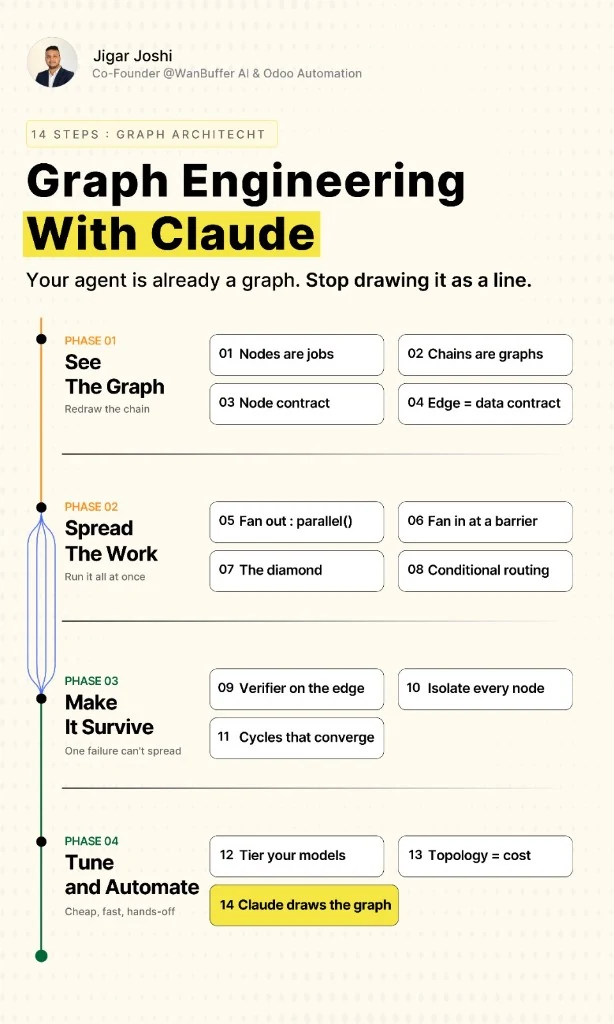
Do not invent a new orchestration shape per project. Map workloads to known patterns: sequential pipelines, parallel fan-out, verifier-gated loops, human checkpoints. The 20 Loop Patterns PDF is the catalog I hand to teams after this whiteboard session.
Before parallelizing, read sequential vs parallel workflow. Wrong execution flow costs 3x latency or breaks correctness.
Conclusion
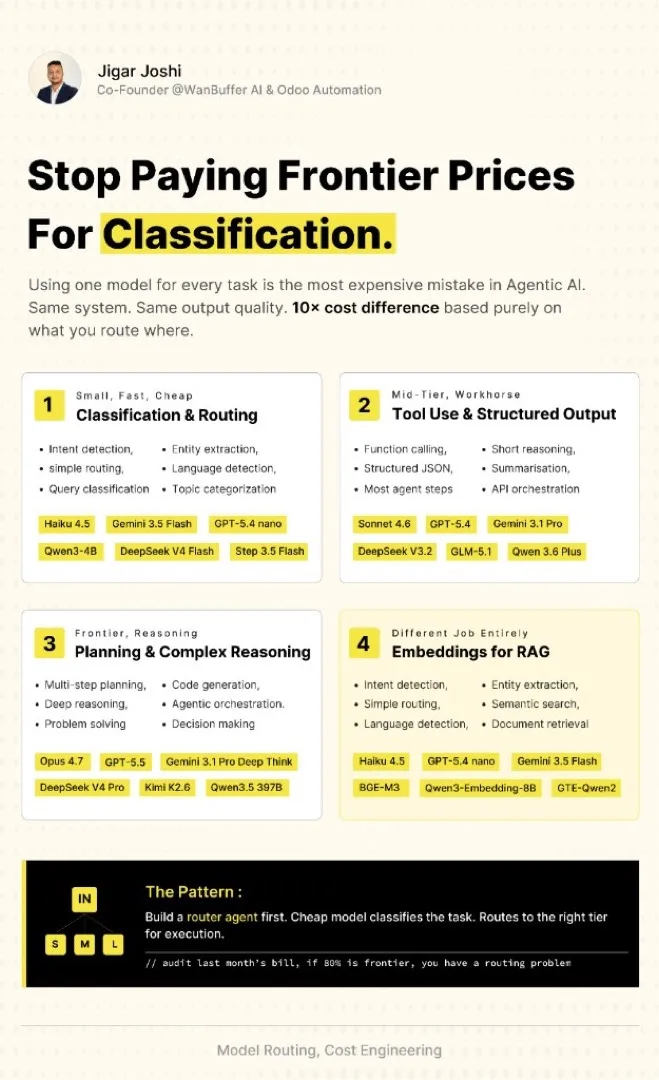
Fable 5 is not a bigger autocomplete. It is a primitive in a four-layer system with an independent verifier and a distillation loop. Build that, or route to Sonnet 5 and save frontier spend.