Anthropic ships tool-use telemetry — every selection is scored and logged at the model boundary
May 13, 2026 · via Anthropic
Agentic AI is the next layer above generative AI: systems that pick tools, take actions, and recover from failure without a human in the loop on every step. This hub gathers the architecture patterns, cost-control techniques, and production lessons that make agents work outside the demo.
An agent is not a chatbot with extra prompts. It is a system that picks a tool, takes an action against the real world, observes the result, and decides what to do next — with exit conditions, retries, and a budget. The difference between a prototype and a production agent is almost entirely in the boring parts: scope, observability, evaluation, and tool design.
Use an agent when the work is multi-step, the steps depend on the previous outputs, and at least one step needs reasoning that scripts cannot encode. Skip agents for deterministic ETL, single-call classification, and any pipeline that runs the same five steps every time — those are scripts, and scripts are cheaper and more reliable.
Pre-agentic data fetching, supervisor-vs-handoff orchestration, descriptive tool names, "when to use" descriptions on every tool, exit conditions on every loop, prompt caching as a first-class metric, evaluation datasets that go beyond the happy path, observability per step. These are the patterns we drill in training and ship in consulting.
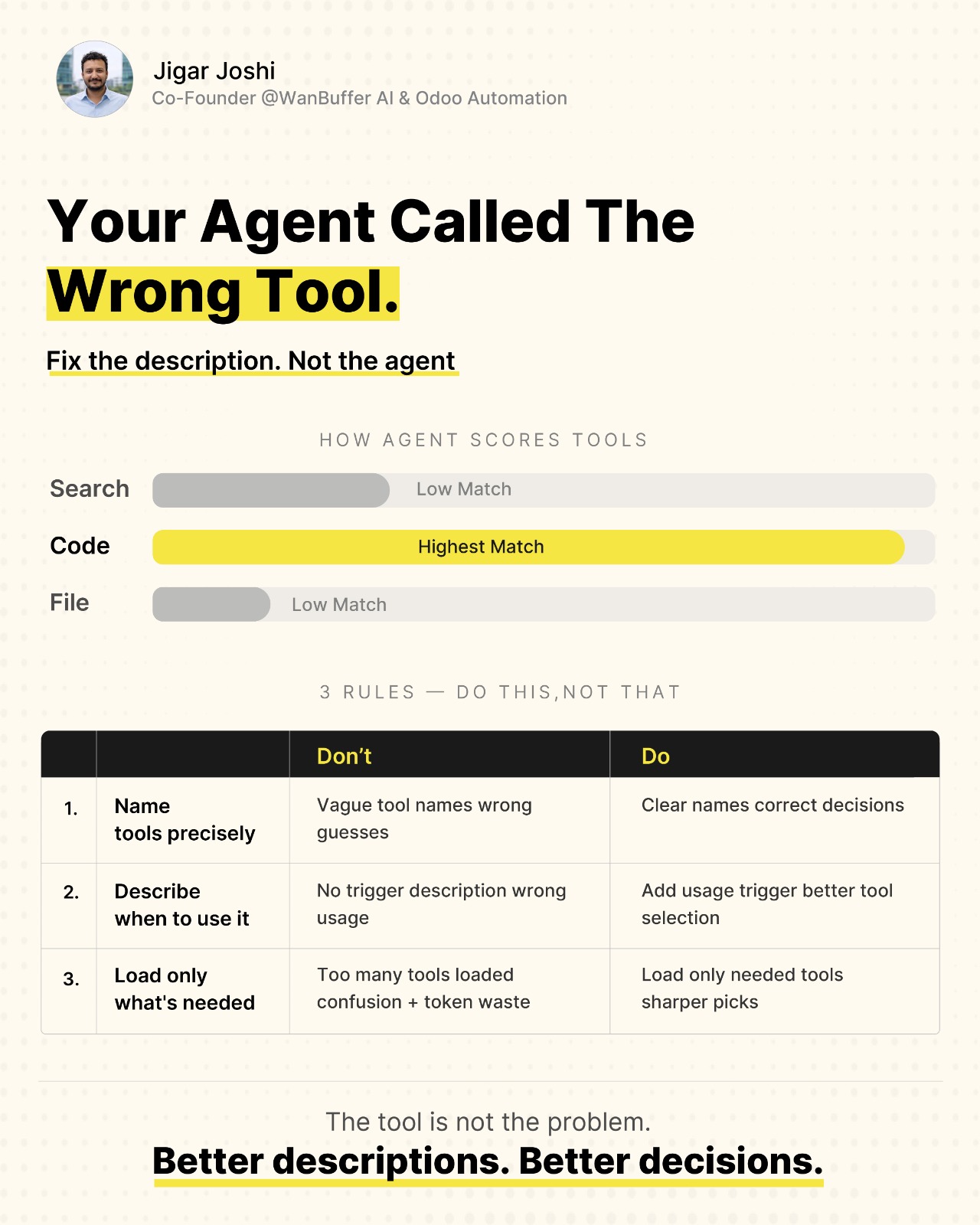
When an agent picks the wrong tool, the registry is broken — not the agent. Three rules I now apply before debugging anything in a multi-tool system: precise names, "when to use" triggers, and a curated load list. Anthropic's new tool-selection telemetry finally puts numbers on what changes accuracy.
GitHub published an instrumented analysis of their agentic CI workflows and reported 19-62% token-cost reductions. The savings are the headline. The technique — pre-agentic data fetching and tool-registry hygiene — is the story most teams will miss.
A million tokens reliably is real now, but it does not retire RAG — it changes the calculus. Cost, latency, recency, and the prompt-cache angle nobody is talking about.
The protocol stabilised. Most working servers will keep working. Three places the new spec actually requires changes — auth profile, server registry, streaming-response semantics — with diffs from a real migration.
Supervisors looked clean on paper and shipped slow in production. Handoffs read messier in the code but recover better when an agent loses the plot. Two real systems and where supervisors still earn their keep.
A walkthrough from a client engagement: identifying stable prefixes, restructuring the system prompt for cacheability, and the telemetry that proved caching was actually working.
A docstring tells a developer what a function does. A tool description tells a model when to call it. Different audience, different writing. Six concrete edits that lifted tool-call accuracy.
Traces, spans, evals, cost-per-completed-task, and the one dashboard panel that catches 80% of regressions. Vendor-agnostic — covers Langfuse, Honeycomb, and rolling your own.
Self-correction loops without budgets, single-agent solutions to multi-domain problems, and using JSON mode to force structure I should have built into the schema. An honest review.
Replacing Sonnet with Haiku in the dispatcher role cut our orchestration cost dramatically. It also cost us in two specific places I did not predict.
Smallest useful server. Hardest one to mess up. Teaches the protocol without distracting domain logic. The 60-line server we hand to teams during training.
If your eval set is the demos you showed the client, you are testing the wrong thing. How we build evals from production failures and the minimum viable suite to ship.
For two years I told teams to avoid forced JSON outputs and use structured tool calls. That was right then and partially wrong now — schema enforcement got better, latency penalties got smaller.
The exit condition problem nobody talks about. Most agents are built for the happy path — where every tool call succeeds and the task completes cleanly. Real production agents are different.
One tool, one purpose. Every tool that does two things will fail you on the third call. I have watched this pattern fail in every team I have trained — and the fix is the same refactor.
A decision framework from real implementations. RAG retrieves. CAG stores in cache. Knowing which to use — and when to combine both — determines whether your agent finds the right answer at the right cost.
The pages below are the buyer-focused, conversion-grade versions of this topic — deliverables, methodology, ROI, security considerations, and CTAs to scope a real engagement.
Designed, built, and handed off — production agentic systems for enterprise teams.
Explore the Agentic AI Consulting solutionCustom Model Context Protocol servers that turn your systems into agent tools.
Explore the MCP Integration solutionMulti-layer safety, policy, and audit controls for agents in regulated environments.
Explore the AI Guardrails solutionEight-day corporate training programs that take dev teams from AI-assisted coding to production agentic systems.
Explore the AI Systems Engineering Training solutionReference architectures for organisations standing up an AI platform — not one agent, but the foundation for many.
Explore the Enterprise AI Architecture solutionTracing, eval, cache-hit telemetry, and cost attribution for production agents.
Explore the AI Observability solutionSupervisor + handoff orchestration for portfolios of agents that need to cooperate without arguing.
Explore the Multi-Agent Workflows solutionOperational agents that replace manual workflows — triage, support, ERP integration, content pipelines.
Explore the AI Automation for Enterprises solutionTwo tracks — one for developers who build agents, one for business teams who use them. Customised to your stack, hands-on from session 1.
See Agentic AI training tracksArchitecture design, production implementation on Claude API and MCP, full observability, and a real handoff. Working agents, not slides.
Explore Agentic AI consultingThe open protocol that gives agents tools.
Orchestrating many agents without losing the plot.
Building production agents on Anthropic's Claude.
Tracing, eval, and telemetry for production agents.
The discipline of shipping AI systems, not demos.
Operational agents for IT services and enterprise teams.