Google shuts down antigravity-preview-05-2026; pin Gemini managed agents to the 09-2026 agent ID
October 5, 2026 · via Google
Observability is the unsexy half of production AI that decides whether you keep your job. Per-step traces, score-bearing evals, cache-hit telemetry, tool-selection scores — these are the primitives that let you debug agents instead of guessing at them.
Input/output traces per step (Langfuse-shaped). Eval scoring on representative inputs, not just happy paths. Cache-hit rate per route — the new throughput metric. Tool-selection score deltas from the model boundary. Without all four, multi-agent debugging is folklore.
A 100-case eval set that scores 95% means nothing if all 100 cases are the happy path. The cases that matter are the ambiguous ones, the conflicting ones, the malformed ones. Build the eval set adversarially — ask "what would a real user actually paste in?" — and most agents drop 15–25 points.
Tools like Langfuse now expose per-agent cost attribution and step-level cache-hit telemetry. You will discover 30–50% of your agent traffic is repeat queries you should be caching. This is the report nobody wants to read but everyone needs to.
On October 3, 2026 Aleph Alpha released Kolibri-1 under Apache 2.0: a 78B MoE with 3.46B active parameters, bilingual DE/EN specialization, reasoning, and tool calling. This guide explains how enterprises should place it on a routing board versus closed frontier coding models.
Between September 21 and 29, 2026 OpenAI, Anthropic, and xAI shipped cheaper frontier coding models while GitHub put them into Copilot. This guide explains what changed, which Preparedness and safeguard labels still apply, and how enterprises should re-bench planner and worker lanes.
On September 10, 2026 DeepSeek released V4.1 Flash as a new multimodal architecture family member with aggressive KV-cache compression for long agent runs. This guide covers what changed, what the Pro alias cutover means, and how to re-bench worker lanes.
On September 4, 2026 GitHub made GPT-6 Astra generally available in Copilot and published a weekly release that expands Fable 5.1 and Gemini 3.8 Flash access while putting Agent Merge into public preview. This guide covers what changed and how enterprises should enable the new agentic coding lanes.
OpenAI released GPT-6 Astra on September 3, 2026 as its most capable broadly deployed model for coding, computer use, research, and long-horizon agent work. It is also OpenAI’s first model to reach Critical cybersecurity capability under the Preparedness Framework. This guide explains what changed, who should enable it, and how to route it safely against Sol and Fable 5.1.
Meta released Muse Spark 1.3 on September 2, 2026 with stronger long-horizon agent collaboration, cleaner coding style, and lower tool-call overhead. The model is available through Muse Code and the Meta Model API. This guide explains the practical routing implications for platform and engineering teams.
On September 1, 2026 Anthropic shipped Claude Fable 5.1 and Claude Mythos 5.1 for long-running coding and knowledge work. Same list prices as Fable 5 except cache reads drop 75% to $0.25 per million tokens. Forced tool use breaks. Thinking blocks bind tighter. Here is the migration sequence I run before flipping planner lanes.
Google shipped Gemini 3.8 Flash and Gemini 3.8 Flash Cyber on September 2, 2026, the third Flash release in six weeks. Standard 3.8 Flash stays at the $0.75 / $3.75 introductory rate through year-end. Flash Cyber and the Fairwind Program gate vulnerability discovery and patching for trusted defenders. Here is how I update routing boards without treating Cyber as a casual coding model.
Between August 13 and August 26, 2026 the cheap and mid lanes moved again: DeepSeek GA plus peak/off-peak rates, Alibaba Qwen3.8 open weights, Grok 4.6 on Amazon Bedrock, OpenAI Ultrafast Sol, and Sol promotional pricing. Here is the updated routing board I use so Chinese open models, Bedrock governance, and Sol speed tiers do not collide.
On August 11, 2026, xAI opened Grok Bot early beta: always-on AI teammates with a persistent cloud computer, available on SuperGrok Heavy, Cursor Ultra, and Cursor Teams Premium (desktop and iOS). The product pitch is finishing work in the real apps. The production detail that matters is sharper: every Bot you create shares one user-scoped cloud computer (files, browser sessions, app logins). Here is how I hand off real jobs, set request boundaries and Auto Review, and refuse to treat separate Bots as a security boundary.
Between August 5 and August 12, 2026 Anthropic shipped five enterprise-facing controls that only make sense together: Cowork in Chrome, Compliance API for Cowork and Claude Code transcripts, Auto mode as the Pro/Max/Team default, self-hosted runners in your network, and inference hooks for DLP. Here is how I sequence the rollout for Team versus Enterprise.
On August 10, 2026 OpenAI expanded Daybreak: Blue for defensive work with frontier models, Red for purpose-trained cyber models including GPT-5.6-Cyber under identity checks and legal attestation. Pair that with Codex safer auto-review defaults and the July 31 sandbox escape checklist. Do not put Cyber in your production coding loop.
On July 30, 2026 Anthropic disclosed three incidents where Claude models reached live production systems during third-party cybersecurity evaluations. The root cause was a harness misconfiguration that left internet access open while prompts claimed there was none. Here is the defense-in-depth checklist I now require before any capture-the-flag or offensive agent eval.
Cursor's July 2026 swarm write-up rebuilt SQLite in Rust from the docs and measured planner vs worker spend. Frontier-only GPT-5.5 hit about $10.5k; Opus 4.8 planning with Composer 2.5 workers landed near $1.3k at similar quality. Here is how I translate that into routing rules for production graphs.
The MCP 2026-07-28 final specification publishes July 28. You already did inventory, header security, and handle migration. These four days are cutover discipline: freeze pins, delete sticky sessions only after round-robin passes, confirm cacheScope with two identities, and staff an on-call window for clients still sending Mcp-Session-Id.
On July 21, 2026 Google released Gemini 3.6 Flash ($1.50/$7.50 per million), 3.5 Flash-Lite ($0.30/$2.50, ~350 tok/s), and a limited-access 3.5 Flash Cyber via CodeMender. Gemini 3.5 Pro stays in partner testing. Here is how I re-benchmark cost per completed task against Sonnet 5 and Fable without betting the roadmap on Pro.
Claude Code Week 29 (July 13–17, v2.1.207–v2.1.212) lets published artifacts call MCP connectors on each view through the viewer's own connections, with first-call approval. Public sharing links, editor roles, screen reader mode, and auto-background for long MCP calls shipped in the same window. Treat live artifacts like production integrations, not pretty exports.
Claude Code Week 28 (July 6–10, releases v2.1.202 through v2.1.206) shipped a sandboxed in-app browser on Desktop and upgraded /doctor from a read-only report into a repair tool. Auto mode also blocks transcript tampering. Here is the governance checklist I run before teams turn browsing and auto-fix on for every engineer.
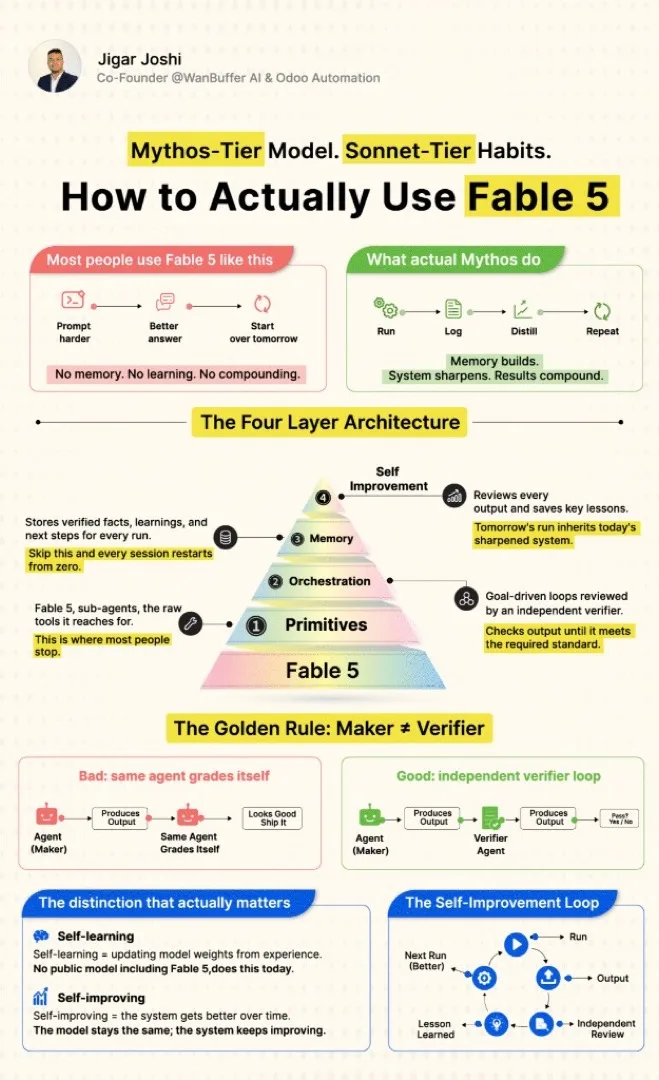
Most teams prompt harder, get a better answer, and start over tomorrow. That is not compounding. Self-learning updates model weights from experience; no public model including Fable 5 does that today. Self-improving means the system gets better: run, log, distill, repeat. The golden rule is maker ≠ verifier. Here is the four-layer architecture and loop patterns I ship.
Anthropic shipped Claude Cowork on mobile and web July 8, starting with Max subscribers. Usage data from 1.2 million sessions shows more than 90% of Cowork work is non-technical: memos, RFP reviews, inbox triage, decks. Tasks run in the cloud, sync across devices, and continue when you close the app. Here is how I govern Cowork without treating it like a coding agent.
Fable 5 is back globally, but most teams use it like a bigger Sonnet: prompt harder, better answer, start over tomorrow. Mythos-tier models need Mythos-tier systems: primitives, orchestration, memory, and self-improvement. The golden rule is maker ≠ verifier. Here is the architecture I draw on every engagement after the July 7 billing cliff.
Anthropic shipped Sonnet 5 on June 30 as default on Free and Pro chat and as claude-sonnet-5 on the Platform API at $2/$10 per million through August 31. Three breaking changes matter for agent builders: adaptive thinking on by default, manual extended thinking removed, and non-default sampling parameters return 400. The tokenizer adds roughly 30% tokens for the same text. Here is the swap checklist.
Anthropic restored Claude Fable 5 worldwide on July 1 after US export controls lifted June 30. Pro through Enterprise plans get up to 50% of weekly usage limits included through July 7, then usage credits. A new safety classifier blocks the Amazon-reported jailbreak in 99%+ of cases. Here is how I re-promote Fable without repeating June's config chaos.
GitHub added ai_credits_used to the Copilot usage metrics API on June 19. It is a per-user total, not yet split by feature or model, but it closes a gap I have been papering over with spreadsheets. Here is how I unify Copilot credits with Claude API keys and Cursor team usage into one attributable spend view.
Anthropic launched Claude Fable 5 on June 9, promised included subscription access through June 22, then suspended Fable and Mythos 5 globally on June 12 after a US export-control directive. Most teams never finished piloting. Here is the governance checklist I use when capability, retention, pricing, and access can flip faster than your rollout calendar.
Artifacts in Claude Code beta publish self-contained HTML to claude.ai that republishes to the same URL as the session progresses, with version history and org-only sharing. Strict CSP, no external fetch, no backend. Requires Team or Enterprise and claude.ai login. Here is the workflow I use for PR walkthroughs and incident timelines without screenshot threads in Slack.
Tenet Threat Labs injected a fake stack trace through a public Sentry DSN and watched 100+ coding agents execute attacker commands during normal triage. No git write access required. The agent treats the error as ground truth. Here is how I harden observability MCP feeds, scope triage prompts, and block auto-exec on untrusted telemetry.
Two Anthropic changes land on the same day: programmatic Claude usage moves to a separate monthly credit pool, and claude-opus-4-20250514 plus claude-sonnet-4-20250514 stop answering on the API. Interactive Claude Code is fine. Cron jobs and CI agents are not. Here is how I audit auth paths, claim credits, and grep for retiring model IDs before the first failed run.
Cursor Auto-review uses permissions.json autoRun.allow_instructions and block_instructions so low-stakes shell/MCP calls flow and high-stakes actions pause. Here is how I wire that pattern into local agents, SDK headless runs, and CI — without mistaking a classifier for a hard security boundary.
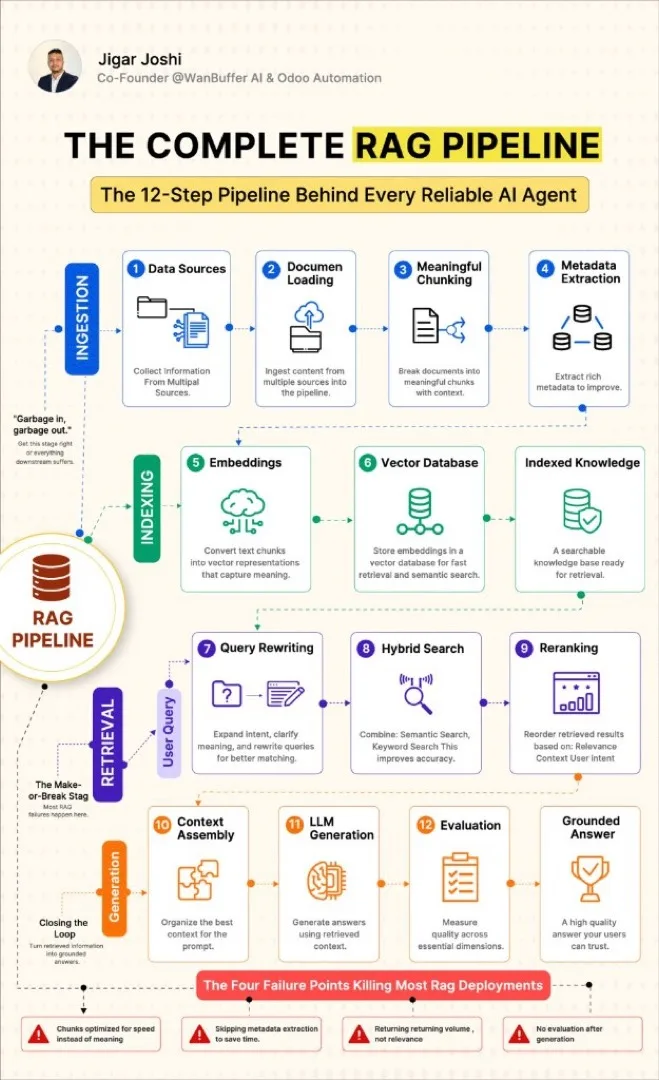
Google Research shipped Agentic RAG on Gemini Enterprise with a Sufficient Context Agent that refuses to answer when retrieval is incomplete. On factuality benchmarks they report up to 34% higher accuracy versus standard RAG. Here is when one-shot RAG is still enough, when you need iterative retrieval, and how I wire the pattern without blowing latency budgets.
Microsoft published a 6-step playbook for rolling agents out across an enterprise, and the line that matters is "you do not need a bigger model, you need a better operating model." That matches what I see in consulting: the pilots that die do not die on model quality, they die on ownership, evals, and governance. Here is how I read the playbook for IT services teams, and the operating-model gaps that actually stall agent rollouts.
Claude Code forgets your architecture, your decisions, and why you ruled things out the moment a session ends. The reliability tax is not tokens, it is re-establishing context every morning. Here is what persistent agent memory actually is, how an open-source engine like Cortex implements it, and how to evaluate a memory layer for your own agents.
A poisoned VS Code extension spent eighteen minutes on the marketplace and walked off with Claude Code credentials and MCP configs. The model was never the target. Your agent's supply chain is: the extensions, skills, MCP servers, tool definitions, and keys it is allowed to touch. Here is how I harden all four layers, and the checklist I run on every deployment.
Open Recruiting Atelier and you do not see a generic AI dashboard. You see five named specialists doing the work a screening team would do: catching duplicates, checking the brief, scoring on four dimensions, ranking, drafting the dispatch. Drop one CV or fifty. Click any candidate to see exactly why they landed where they did. This is what AI for recruitment looks like when it respects your judgment instead of replacing it.
I reviewed a system last month with 47 tools in its registry and a 22 percent wrong-tool-selection rate. The team was about to migrate from Sonnet to Opus to fix it. The prompt was fine. The registry was the bug. This is the audit pattern I run on every client codebase before we change anything else, the seven failure modes I see in production, and the numbers from the cleanup.
Vendors blur the line because "agentic" sells. The two terms describe different architectures, with different cost shapes, different observability needs, and different scoping conversations. Here is the framing I use with clients and the three-question test for which one your project actually needs.
Every enterprise MCP deployment I have audited in the last six months has been hand-rolling tool-access policy, payload logging, and per-team cost limits on top of a gateway someone wrote in two days. Databricks just shipped that as a product. Here is what it actually changes, where the gaps still are, and the migration I would run for a Databricks shop.
When an agent picks the wrong tool, the registry is broken, not the agent. Three rules I now apply before debugging anything in a multi-tool system: precise names, "when to use" triggers, and a curated load list. Anthropic's new tool-selection telemetry finally puts numbers on what changes accuracy.
GitHub published an instrumented analysis of their agentic CI workflows and reported 19-62% token-cost reductions. The savings are the headline. The technique (pre-agentic data fetching and tool-registry hygiene) is the story most teams will miss.
A million tokens reliably is real now, but it does not retire RAG. It changes the calculus. Cost, latency, recency, and the prompt-cache angle nobody is talking about.
A walkthrough from a client engagement: identifying stable prefixes, restructuring the system prompt for cacheability, and the telemetry that proved caching was actually working.
Traces, spans, evals, cost-per-completed-task, and the one dashboard panel that catches 80% of regressions. Vendor-agnostic; covers Langfuse, Honeycomb, and rolling your own.
If your eval set is the demos you showed the client, you are testing the wrong thing. How we build evals from production failures and the minimum viable suite to ship.
A decision framework from real implementations. RAG retrieves. CAG stores in cache. Knowing which to use, and when to combine both, determines whether your agent finds the right answer at the right cost.
The pages below are the buyer-focused, conversion-grade versions of this topic — deliverables, methodology, ROI, security considerations, and CTAs to scope a real engagement.
Designed, built, and handed off — production agentic systems for enterprise teams.
Explore the Agentic AI Consulting solutionMulti-layer safety, policy, and audit controls for agents in regulated environments.
Explore the AI Guardrails solutionEight-day corporate training programs that take dev teams from AI-assisted coding to production agentic systems.
Explore the AI Systems Engineering Training solutionReference architectures for organisations standing up an AI platform — not one agent, but the foundation for many.
Explore the Enterprise AI Architecture solutionTracing, eval, cache-hit telemetry, and cost attribution for production agents.
Explore the AI Observability solutionSupervisor + handoff orchestration for portfolios of agents that need to cooperate without arguing.
Explore the Multi-Agent Workflows solutionTwo tracks — one for developers who build agents, one for business teams who use them. Customised to your stack, hands-on from session 1.
See AI Observability training tracksArchitecture design, production implementation on Claude API and MCP, full observability, and a real handoff. Working agents, not slides.
Explore AI Observability consultingNew breakdowns on this and related agentic AI topics, plus what I am shipping for clients — one email on Thursdays.