Introduction
I open client AWS and Anthropic bills and the pattern repeats: Opus on intent detection, Opus on language classification, Opus on "is this a refund question." Same output quality. Ten times the cost.
Model routing is not a nice-to-have anymore. It is the difference between a demo budget and a production budget. This note is the four-tier map I draw before anyone touches a prompt.
Four model tiers
| Tier | Job | Example models |
|---|---|---|
| Tier 1: Small, fast, cheap | Classification, routing, entity extraction | Haiku 4.5, Gemini 3.5 Flash, GPT-5.4 nano |
| Tier 2: Mid-tier workhorse | Tool use, structured JSON, most agent steps | Sonnet 4.6, GPT-5.4, Gemini 3.1 Pro |
| Tier 3: Frontier reasoning | Multi-step planning, hard code, orchestration | Opus 4.8, GPT-5.5, Gemini 3.1 Pro Deep Think |
| Tier 4: Embeddings | Semantic search, document retrieval (not generation) | BGE-M3, Qwen3-Embedding-8B, GTE-Qwen2 |
Build the router agent first
A cheap model classifies the task, then hands execution to the right tier. The router needs typed output, exit conditions, and an eval suite built from production mis-routes.
- 01Define route taxonomyClassification, tool call, reasoning, retrieval. Four routes, four tiers. No fifth category until you have data.
- 02Run shadow modeLog what the router would have picked without changing production routes. Compare against actual outcomes for two weeks.
- 03Promote per routeFlip one route at a time, not stack-wide. Measure cost per completed task on your eval set, not list price per token.
- 04Audit monthly by model IDIf roughly 80% of spend is frontier, you have a routing problem, not a capability problem.
Where each tier belongs in agent pipelines
The five-agent content quality pipeline is a worked example: Haiku on pattern checks, Sonnet on structured eval, Opus only on rewrite. Same pattern applies to support triage, document processing, and code review agents.
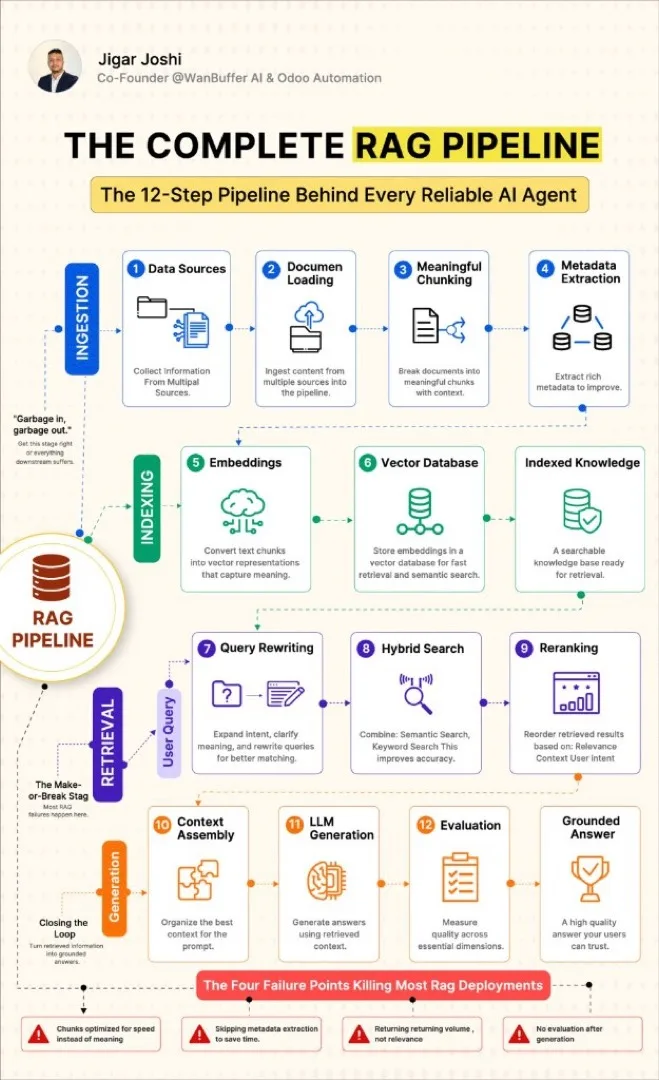
Tier 4 is a different product job entirely. Do not run a generation model where an embedding model plus vector index is the right tool. See the complete RAG pipeline for where embeddings sit in the stack.
Conclusion
The cost metric that matters is cost per completed task on your eval set. Audit last month's bill by model ID. Build the router before you tune prompts on the frontier model. Same quality on classification. Up to 10x lower cost if you route right.