Claude Code adds parallel sub-agent execution — multi-file refactors land in a single turn
May 13, 2026 · via Anthropic
AI engineering is the discipline that sits between "the model can do this" and "this runs in production for paying users." It is mostly the un-glamorous parts — tool registries, exit conditions, retries, eval suites, observability — that decide whether your agent works on day 30, not just day one.
Supervisor patterns gave way to handoffs. Inline tool descriptions gave way to externalised, per-tool selection criteria. "Use this when…" beat "this function returns…" every time. JSON mode replaced bespoke parsers. RAG-by-default got replaced by a measure-then-decide framework. These are the moves that separate engineering from improv.
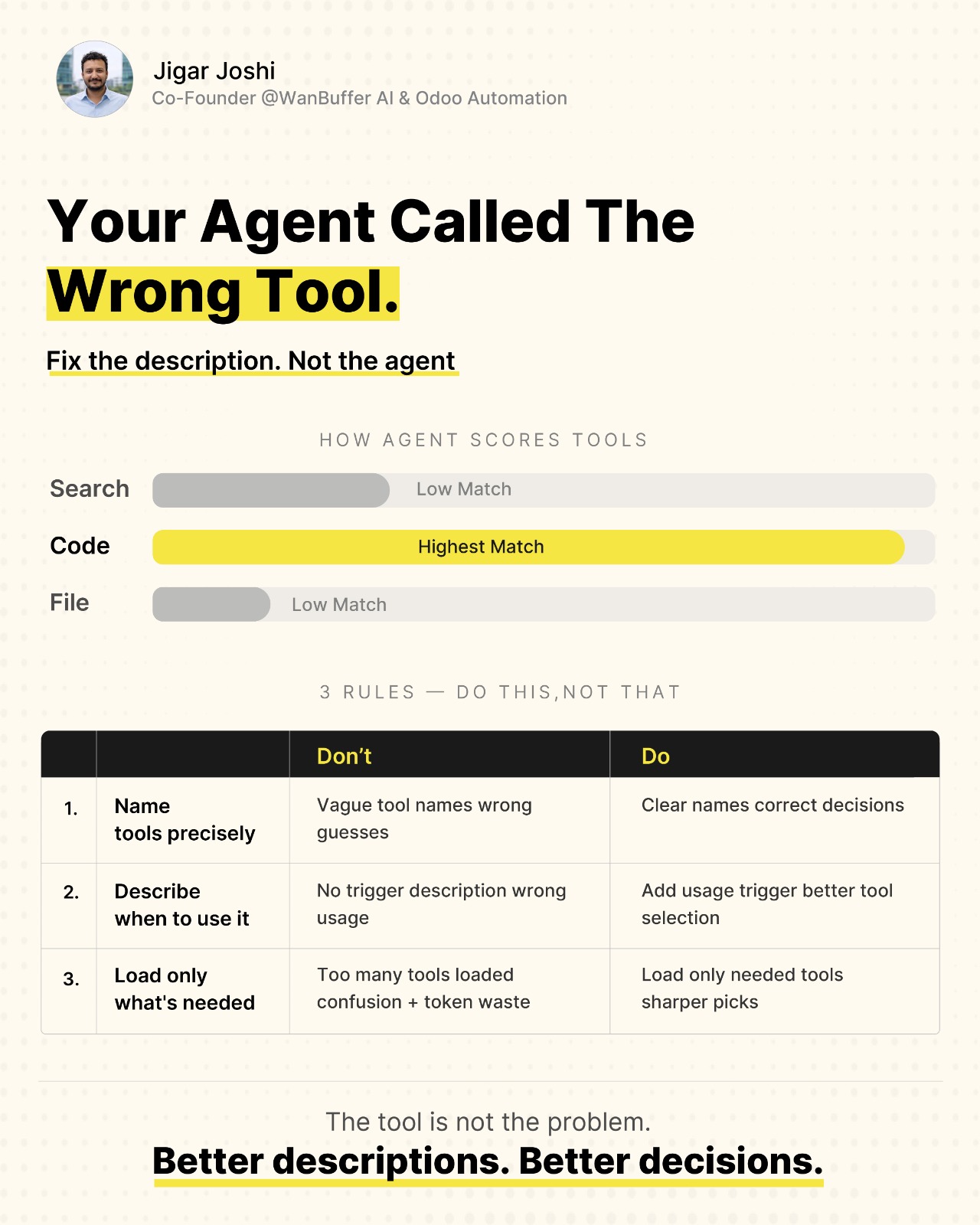
When an agent picks the wrong tool, the registry is broken — not the agent. Three rules: name tools precisely, describe when to use each one, load only what the task needs. Anthropic's tool-use telemetry finally puts numbers on what changes accuracy.
The cheapest LLM call is the one you do not make. Pre-agentic data fetching, prompt caching, and registry pruning compound into 30–60% cost reductions on real workflows — before you touch a prompt. Cost is not a post-launch concern; it is a design constraint from day one.
When an agent picks the wrong tool, the registry is broken — not the agent. Three rules I now apply before debugging anything in a multi-tool system: precise names, "when to use" triggers, and a curated load list. Anthropic's new tool-selection telemetry finally puts numbers on what changes accuracy.
GitHub published an instrumented analysis of their agentic CI workflows and reported 19-62% token-cost reductions. The savings are the headline. The technique — pre-agentic data fetching and tool-registry hygiene — is the story most teams will miss.
A million tokens reliably is real now, but it does not retire RAG — it changes the calculus. Cost, latency, recency, and the prompt-cache angle nobody is talking about.
Supervisors looked clean on paper and shipped slow in production. Handoffs read messier in the code but recover better when an agent loses the plot. Two real systems and where supervisors still earn their keep.
A walkthrough from a client engagement: identifying stable prefixes, restructuring the system prompt for cacheability, and the telemetry that proved caching was actually working.
A docstring tells a developer what a function does. A tool description tells a model when to call it. Different audience, different writing. Six concrete edits that lifted tool-call accuracy.
Traces, spans, evals, cost-per-completed-task, and the one dashboard panel that catches 80% of regressions. Vendor-agnostic — covers Langfuse, Honeycomb, and rolling your own.
Self-correction loops without budgets, single-agent solutions to multi-domain problems, and using JSON mode to force structure I should have built into the schema. An honest review.
If your eval set is the demos you showed the client, you are testing the wrong thing. How we build evals from production failures and the minimum viable suite to ship.
For two years I told teams to avoid forced JSON outputs and use structured tool calls. That was right then and partially wrong now — schema enforcement got better, latency penalties got smaller.
The exit condition problem nobody talks about. Most agents are built for the happy path — where every tool call succeeds and the task completes cleanly. Real production agents are different.
One tool, one purpose. Every tool that does two things will fail you on the third call. I have watched this pattern fail in every team I have trained — and the fix is the same refactor.
A decision framework from real implementations. RAG retrieves. CAG stores in cache. Knowing which to use — and when to combine both — determines whether your agent finds the right answer at the right cost.
The pages below are the buyer-focused, conversion-grade versions of this topic — deliverables, methodology, ROI, security considerations, and CTAs to scope a real engagement.
Designed, built, and handed off — production agentic systems for enterprise teams.
Explore the Agentic AI Consulting solutionCustom Model Context Protocol servers that turn your systems into agent tools.
Explore the MCP Integration solutionMulti-layer safety, policy, and audit controls for agents in regulated environments.
Explore the AI Guardrails solutionEight-day corporate training programs that take dev teams from AI-assisted coding to production agentic systems.
Explore the AI Systems Engineering Training solutionReference architectures for organisations standing up an AI platform — not one agent, but the foundation for many.
Explore the Enterprise AI Architecture solutionTracing, eval, cache-hit telemetry, and cost attribution for production agents.
Explore the AI Observability solutionSupervisor + handoff orchestration for portfolios of agents that need to cooperate without arguing.
Explore the Multi-Agent Workflows solutionOperational agents that replace manual workflows — triage, support, ERP integration, content pipelines.
Explore the AI Automation for Enterprises solutionTwo tracks — one for developers who build agents, one for business teams who use them. Customised to your stack, hands-on from session 1.
See AI Engineering training tracksArchitecture design, production implementation on Claude API and MCP, full observability, and a real handoff. Working agents, not slides.
Explore AI Engineering consultingDesigning, building, and shipping production agents.
The open protocol that gives agents tools.
Orchestrating many agents without losing the plot.
Building production agents on Anthropic's Claude.
Tracing, eval, and telemetry for production agents.