Scheduled agent runs: OpenAI automations, Claude Code 2.1.310, and Nanbeige4.3-33B
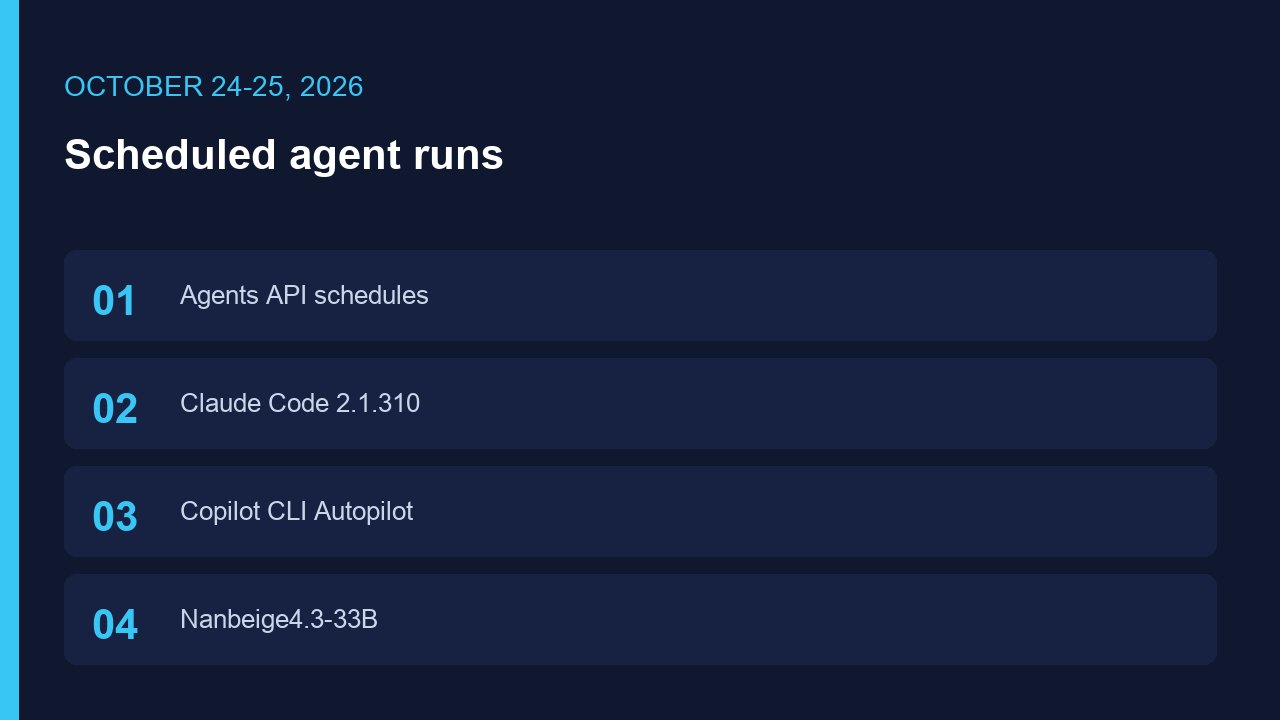
October 24, 2026 added a cron for OpenAI agent sessions, a Claude Code control release, a Copilot CLI Autopilot wait fix, and an Apache 2.0 33B agent model. October 25 did not add a second primary model launch.
 Jigar JoshiAgentic AI Architect and Consultant
In this post (12 sections)
Introduction
OpenAI agent automations are the headline because they change when an agent is allowed to start work, not only which model answers. A builder who previously needed an external scheduler for a daily review can now store that schedule on the Agents API. A buyer who treats a delivered invocation as finished work will mis-read the new status model. The same two days also shipped a Claude Code control release, a Copilot CLI pre-release that changes Autopilot waiting, and an Apache 2.0 33B model aimed at coding agents. This guide places each one.
Nothing here repeats the October 22-23 routing board. Kimi K3.1 Pro, the Decisions API, MiniMax M3.1 Flash weights, Nemotron Bolt, and Grok Bot Pages and Vault stay in the October 22-23 agent routing guide. OpenAI storage scaling and the frontier training-environment post are already dated October 23 in the feed. This piece starts the next morning.
What shipped on October 24 and 25
| When (IST) | What | Who | Why a builder should care |
|---|---|---|---|
| Oct 24, 02:54 | Scheduled automations on the Agents API | OpenAI | A session can start on a cron or a future timestamp. An invocation is delivery, not completion. |
| Oct 24, 05:09 | Claude Code 2.1.310 | Anthropic | Cloud sessions and Remote Control can be gated by enterprise custom role. Monitor reaches Bedrock, Vertex, and Foundry. |
| Oct 24, 06:36 | Copilot CLI 1.0.104-2 | GitHub | Interactive and SDK Autopilot keep waiting on attached background tasks. Headless -p --autopilot still honors the timeout. |
| Oct 24, 08:19 | Nanbeige4.3-33B on Hugging Face | Nanbeige | Apache 2.0, 512K context, vendor agent scores against Qwen3.8-27B. A 3B student is announced and not released. |
| Oct 25 | Model card update only | Nanbeige | The 33B card was modified. No second primary model launch cleared the sourcing bar. |
What OpenAI agent automations change
OpenAI’s developer community post is timestamped 21:24 UTC on October 23, 2026, which is 02:54 on October 24 in India. The capability lives in the Agents API under the beta header OpenAI-Beta: agents=v1. An automation is a saved schedule. Each run creates an invocation, which is a record that the API tried to send a task into a session. If that session is busy, the task waits. Following session events is still required. Delivery does not mean the agent finished the work.
Two targets and two clocks
| Choice | Fields | Use it when |
|---|---|---|
| new_session | agent id, environment, target.input | The job is independent, such as a monthly review that should not inherit yesterday’s thread. |
| existing_session | session id and target.instructions | The job needs earlier findings in that same session. |
| periodic | five-field cron expression and a named time zone | The work repeats. OpenAI adds a small randomized delay so recurring runs do not all land at once. |
| once | a future run_at timestamp | The work should happen one time. A completed one-time automation cannot be resumed. Create another automation for the next follow-up. |
The automations tool is off unless the application adds it. With the tool on, the agent can create, list, get, update, pause, resume, and delete schedules for its current session only. It cannot start a new session through that tool, and it cannot manage another session’s automations. Removing the tool from the agent configuration does not delete saved schedules. Pause or delete those through the API. A manual POST to the invocations endpoint runs a saved automation immediately, does not consume a one-time scheduled run, and still works while the schedule is paused.
- Pause holds pending scheduled deliveries. It does not block a manual invocation.
- If a one-time run_at passes while the automation is paused, set a new future run_at before resuming.
- A busy target session delays the task. The schedule time is the intended time, not a completion promise.
- The SDKs send the beta header. A raw cURL call has to send OpenAI-Beta: agents=v1.
This is a different lane from the Decisions API, which answers a bounded question inside a hot path. Automations decide when a whole session starts. Teams that already run the OpenAI Agents API can retire a side scheduler only after they log invocation status separately from session completion. Pair that log with the agent observability stack so a waiting session is visible.
Claude Code 2.1.310, dated for India
GitHub published Claude Code v2.1.310 at 2026-10-23T23:39:00Z. That is 05:09 on October 24 in India, so it belongs in this window and not in the October 23 feed. The release is a control and reliability drop. It is not a new Claude model.
What an enterprise admin can now gate
Cloud sessions and Remote Control permissions are now part of Enterprise custom roles. An Owner can grant each one by role. Turning either setting on in admin settings asks for confirmation and lists the custom roles that already have the permission. That is the action item: review those roles before the next cloud-agent rollout, and do not assume every role that could use Claude Code can also open a cloud session.
- Monitor and plugin monitors now run on Bedrock, Vertex, and Foundry, including when telemetry or nonessential traffic is disabled. Long foreground sleeps are blocked in those setups.
- Windows: a PreToolUse or PermissionRequest hook no longer lets a tool call through when Git Bash is missing and the hook command is only quoted strings.
- Requests behind some gateways that reject the effort-2025-11-24 beta value, or mid-conversation system messages, retry without those values.
- A non-interactive MCP tool call that times out because elicitation was never answered now tells the model that no answer came and not to repeat the call.
- Compaction after a “Prompt is too long” error keeps less of a dense transcript, such as base64 or SVG, so the next request is less likely to fail the same way.
- VS Code: Enter on the plan review card’s “Send feedback and keep planning” button sends comments. It no longer approves the plan.
Hosted Claude on Bedrock, Vertex, or Foundry should be upgraded before relying on Monitor there. Windows fleets should treat the quoted-hook fix as a permission bug, not a cosmetic changelog line. The elicitation change matters for Agent SDK and -p sessions: a server that asks a person for input will not get one, and Claude Code will now stop the retry loop. Disable elicitation on those servers, or keep the session interactive. MCP enterprise managed authorization still governs which servers are allowed in the first place. Approval habits from Claude Duet remain the pattern for any agent that can send, pay, or delete.
Copilot CLI Autopilot stops abandoning background work
GitHub published Copilot CLI v1.0.104-2 at 2026-10-24T01:06:24Z. It is marked pre-release. Two fixes are specific enough to change operations. Managed model “fusion” now starts sessions on Auto and applies fusionTier settings. Interactive sessions and SDK Autopilot sessions keep waiting for attached background tasks. They no longer stop when COPILOT_TASK_WAIT_TIMEOUT_SECONDS elapses. The headless form, -p --autopilot, still honors that timeout.
Read that split before rolling the build out. A person watching an interactive session, or an SDK job that is supposed to stay attached, will now wait. A scripted -p --autopilot run will still end when the timeout fires. Pin the CLI version in the image, then test both entry points. A later same-day tag, 1.0.104-3, was published at 15:28 UTC with no additional notes on the release page. Do not assume 1.0.104-3 changed this behavior. The notes that exist are the 1.0.104-2 notes.
Organization model policy still lives in the Copilot managed settings guide. The fusion fix is about sessions starting on Auto under a managed default. It does not replace the policy that decides which models Auto may pick.
Nanbeige4.3-33B, an Apache 2.0 teacher model
Hugging Face records Nanbeige/Nanbeige4.3-33B as created at 2026-10-24T02:49:18Z and last modified on October 25. The license tag is Apache 2.0. The card describes a dense 33B model with a 524,288-token context, built as the teacher for a later Nanbeige4.3-3B that is not in this release. Contact on the card is nanbeige@kanzhun.com. Serving examples use Transformers with trust_remote_code, plus SGLang and vLLM with the Qwen3 reasoning parser and the qwen3_coder tool-call parser, typically split across four GPUs.
What the vendor table actually says
The card compares Nanbeige4.3-33B with Qwen3.8-27B, Muse-Glimmer-30B, and Gemma4-31B at the highest thinking effort, and says the same inference hyperparameters and harness were used across models. Those numbers are Nanbeige’s. On Terminal-Bench 2.1 with Terminus 2, the card lists 80.9 against 73.0 for Qwen3.8-27B. On DeepSWE with mini-swe-agent v2.4.6, it lists 65.5 against 42.5. On SWE-Bench Pro with the same agent, Qwen3.8-27B is ahead at 61.7 against 60.3. On GDPval, Qwen is ahead at 86.4 against 84.8. Terminal-Bench 4.0 is listed at 23.8 against 6.3, which is a large gap on a hard set and still a vendor measurement.
The chat template has two switches that change agent behavior. enable_thinking defaults to on. preserve_thinking keeps prior assistant reasoning in a multi-turn transcript. The card recommends preserve_thinking true for multi-turn tool use, office tasks, and code-agent workflows, and false for ordinary chat. It recommends tool_call_format xml, with json available for compatibility. Recommended sampling for agentic and tool-use tasks is temperature 1.0, top_p 0.95, and up to 65,536 new tokens.
- Treat the Apache 2.0 license as the reason a platform team can evaluate self-hosting. Confirm the file on the repository before a procurement note.
- Review any custom code loaded by trust_remote_code before a shared endpoint serves it.
- Do not promote the 33B over Qwen3.8-27B on SWE-Bench Pro. The card’s own row does not support that.
- Do not wait on Nanbeige4.3-3B. The card calls that distillation upcoming.
- Re-bench against the current open worker, including the MiniMax M3.1 Flash lane and the DeepSeek Flash-1017 lane, on accepted diffs and cost, not on the vendor table alone.
How the new lanes compare
| Need | Use | Do not treat it as |
|---|---|---|
| Start an Agents API session later or on a cron | Scheduled automations | Proof that the agent finished |
| Gate cloud sessions and Remote Control by role | Claude Code 2.1.310 enterprise roles | A new model release |
| Keep an interactive Autopilot session attached to background tasks | Copilot CLI 1.0.104-2 | A change to headless -p --autopilot timeouts |
| Self-host a ~30B Apache 2.0 coding agent for a bake-off | Nanbeige4.3-33B | A drop-in replacement for Qwen3.8-27B on SWE-Bench Pro |
What it means for developers
Split the work by clock, permission, and weight file. Automations belong in the application that already owns an agent id and a session id. Claude Code 2.1.310 belongs in the developer environment and in the enterprise admin console. Copilot CLI 1.0.104-2 belongs in the image tag for interactive and SDK jobs, with a separate test for -p --autopilot. Nanbeige4.3-33B belongs on a GPU box with the Qwen3 parsers, preserve_thinking on for tool loops, and a harness the team already trusts.
A scheduled agent that shares tools with an interactive agent needs the same allowlist. The new cron does not add a safer tool policy. If the session can call MCP servers, the servers allowed on a Monday morning run should be the servers allowed in the afternoon, or a stricter set. Log the invocation id, the session id, and the terminal session status as three fields.
What it means for businesses
The buyer question is operational. Who is allowed to turn on a schedule, who is allowed to open a cloud session, and which open-weight model is allowed onto a GPU that can see source code. OpenAI’s pause and delete controls are the off switch for a cron that should not keep firing after a project ends. Claude Code’s custom-role prompt is the off switch for cloud sessions. Nanbeige’s Apache 2.0 tag removes a license negotiation that MiniMax’s community license still requires, and it does not remove the need for an eval.
October 25 is intentionally thin. The Nanbeige card changed that day. Anthropic’s newsroom shows an October 26 item, which is outside this window because that day is not complete. No Grok Bot changelog entry is dated October 24 or October 25. The October 23 Vault and Pages notes stay where they are.
A practical scheduling pilot
- 01Pick one recurring jobChoose a review that already runs on an external cron and already has a written definition of done. Do not start with a job that sends email, pays, or deletes.
- 02Create a paused periodic automationUse a five-field cron, a named time zone, and new_session if the run should not inherit chat history. Leave the automations tool off until a person has created the schedule through the API.
- 03Fire one manual invocationPOST an invocation while the schedule is still paused. Confirm the session id, then confirm a separate completion signal. Promote the schedule only after both exist in the log.
- 04Upgrade the coding agents on a branchPut Claude Code 2.1.310 on one team and Copilot CLI 1.0.104-2 on one image. Check the Windows hook path, the plan-review button, and both Autopilot entry points.
- 05Bench the 33B offlineRun Nanbeige4.3-33B with preserve_thinking on and the Qwen3 tool parser, next to the current open model, on ten tasks the team already scores. Keep it off the production router until accepted diffs and cost are both recorded.
Common mistakes
- Treating an automation invocation as a finished agent run.
- Leaving saved schedules in place after the automations tool is removed from the agent.
- Resuming a one-time automation whose run_at already passed while it was paused, without setting a new future time.
- Assuming Claude Code 2.1.310 is an October 23 India release. The tag time is October 24, 05:09 IST.
- Expecting -p --autopilot to wait the way interactive Autopilot now waits.
- Quoting Nanbeige’s DeepSWE score without the harness, or ignoring the SWE-Bench Pro row where Qwen3.8-27B is ahead.
- Loading the Transformers example with trust_remote_code on a shared server before the custom code is reviewed.
Conclusion
October 24, 2026 is a control-plane day. OpenAI agent automations put the clock on the Agents API, with an invocation record that must stay separate from completion. Claude Code 2.1.310 gives enterprise roles a real gate on cloud sessions and Remote Control, and it closes a Windows hook bypass. Copilot CLI 1.0.104-2 stops interactive Autopilot from abandoning background tasks, and it leaves the headless timeout in place. Nanbeige4.3-33B is an Apache 2.0 teacher model worth a private bake-off, with the vendor’s own table showing it does not lead every coding benchmark. October 25 did not add a second launch of the same weight.
Sources: OpenAI scheduled automations, OpenAI community announcement, Claude Code v2.1.310, Copilot CLI v1.0.104-2, and Nanbeige4.3-33B.
Agentic AI patterns, delivered Thursdays
What I am shipping, watching, and pruning out of client stacks each week. One email. No fluff.