Kimi K3.1 Pro and the October 22-23 agent routing board
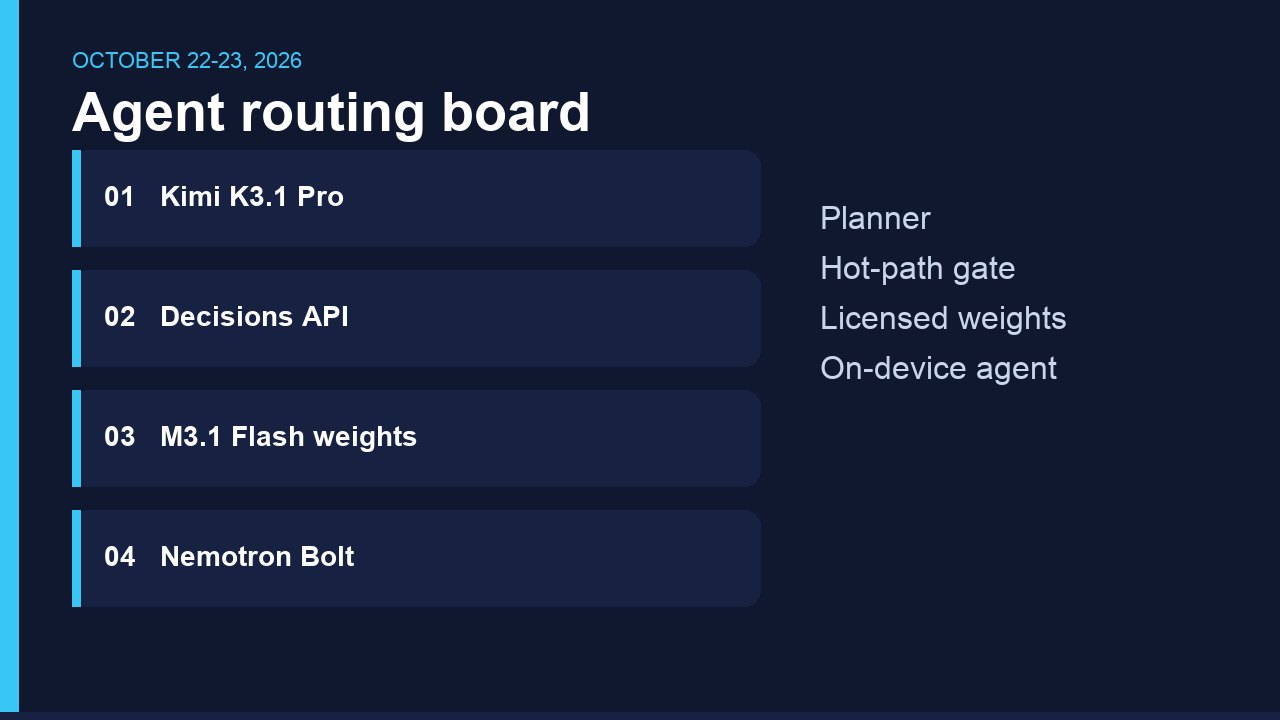
On October 22 and 23, 2026 Moonshot opened Kimi K3.1 Pro, OpenAI made the Decisions API generally available, MiniMax published M3.1 Flash weights, and NVIDIA shipped an on-device conversational agent model. This guide covers what actually shipped, what is still vendor-reported, and how to place each lane.
 Jigar JoshiAgentic AI Architect and Consultant
In this post (13 sections)
Introduction
Kimi K3.1 Pro is the headline, and it is the wrong thing to adopt in isolation. In the same two days, OpenAI productized the small decision an agent makes hundreds of times per task, MiniMax turned its cheap computer-use model into downloadable weights, and NVIDIA aimed a 4 GB model at voice and device agents. GitHub started naming the custom agents and MCP servers an organization actually uses. Cursor bound self-hosted workers to a selected team. xAI let Grok Bot keep a living page and store logins in a vault.
Those are not one story about a smarter chatbot. They are a routing board: which model plans, which model decides the next step, which model can be self-hosted, which model stays on a device, and which control plane records the tools. This guide uses primary announcements only. Vendor benchmark figures are labeled as vendor-reported. Scores that were not in the vendor post are left out.
Primary sources: Kimi K3.1 Pro, Decisions API, MiniMax-M3.1-Flash on Hugging Face, Nemotron 3.5 Bolt E4B 4GB, Copilot usage metrics, Copilot default policy, Cursor CLI changelog, and the Grok Bot changelog. Adjacent guides: MiniMax M3.1 Flash API pricing, DeepSeek Flash-1017, GPT-6 Sol and Opus 5.5 routing, and Copilot managed settings.
What shipped on October 22 and 23
| Date | Ship | Who | What changes for a builder |
|---|---|---|---|
| Oct 23 | Kimi K3.1 Pro and Highspeed | Moonshot / Kimi | New planner candidate. Weights by Nov 4. Enterprise off by default. |
| Oct 23 | MiniMax-M3.1-Flash weights | MiniMax | Self-host path opens. License is not Apache 2.0. |
| Oct 23 | Nemotron 3.5 Bolt E4B 4GB | NVIDIA | On-device conversational agent with tool use, about 4 GB at Q4. |
| Oct 23 | Grok Bot 0.75.5 Vault | xAI | Bots can store logins, cards, and contacts. Approval behavior changed. |
| Oct 22 | Decisions API general availability | OpenAI | Bounded choices on GPT-6 Luna. Input-token pricing. No output charge. |
| Oct 22 | Grok Bot 0.75.2 Pages | xAI | Reports, memos, and dashboards the bot can keep current. |
| Oct 22 | Named skills, agents, and MCP in usage metrics | GitHub | Admins can see which internal customizations are used. |
| Oct 22 | Copilot global default enforcement | GitHub | Unconfigured GA features follow the org default through Oct 26. |
| Oct 22 | Cursor CLI v2026.10.22 | Cursor | Cloud environment redeploy, team-scoped workers, subagent model fallback. |
Not on this board: token-usage leaderboards, funding, and partner-network announcements. They do not change a build or a buy decision. Video models that do not alter agent control are out as well.
What Kimi K3.1 Pro changes for coding agents
Moonshot describes Kimi K3.1 Pro as the first model in the K3.1 series and its most capable 3T-class open-weight model so far, with a 1 million token context window. Kimi K3.1 Pro Highspeed is the same capability class at roughly 2 to 3 times the speed. Both are live on Kimi.com, the Kimi mobile apps, Kimi Work 3.1.0 or later, Kimi Code, and the Kimi API. Full weights are scheduled by November 4, 2026. Until that date, this is an API and product model, not a file a platform team can pin.
How to call it
- API model IDs are kimi-k3.1-pro and kimi-k3.1-pro-highspeed.
- Thinking stays on. Kimi Code documents a 400 error if thinking is disabled.
- reasoning_effort accepts low, high, or max. The default is max.
- Kimi says reported results use max effort, temperature 1.0, and top_p 0.95 unless noted.
- Kimi Enterprise access is off by default. An administrator has to enable the model.
- Zero Data Retention is available for API customers, according to Kimi. Confirm the contract before sending production prompts.
- Start a new Kimi Code session. Kimi warns that switching into K3.1 inside an older K3, K2.8, or K2.7 session can change behavior and cache hits.
What the vendor table actually says
Kimi reports Terminal-Bench 4.0 at 65.7 percent for K3.1 Pro, using a Claude Code harness. In the same table, Kimi lists GPT-6 Astra at 58.2 percent and Claude Opus 5.5 at 66.4 percent. On the internal Kimi Code Bench 3.0 Long-horizon set, Kimi reports 61.2 percent against 55.95 percent for K3. On BenchCAD with tools, Kimi reports 92.7 percent, against 96.2 percent for Claude Opus 5.5 and 95.9 percent for GPT-6 Astra. These are Kimi’s numbers, mostly collected with Kimi’s chosen harness. They are a reason to run a bake-off. They are not a reason to retire Opus 5.5.
The cyber section matters for anyone waiting on the November 4 weights. Kimi says it removed cyber-related data from mid-training and from the reinforcement-learning mix for the open-weight checkpoint. On its internal xdev-bench-hard set, the unfiltered checkpoint solved 90.5 percent of tasks at pass@3 and the released K3.1 Pro solved 81.0 percent. Kimi also says the released model remains behind frontier proprietary models that have been public for at least three months. Treat that as a vendor risk statement, not as an independent red-team report. Offensive evaluation stays in an approved lab.
Place K3.1 Pro next to the existing planner lane in GPT-6 Sol, Luna, Opus 5.5, and Grok 4.7 routing and the open-weight lane in Muse Spark Open. It does not replace a worker that is already winning on cost per accepted task, which is the question the MiniMax API guide and the DeepSeek Flash-1017 guide were written to answer.
OpenAI Decisions API for hot-path agent choices
On October 22, 2026 OpenAI made the Decisions API generally available. It is built on GPT-6 Luna and is meant for questions with a bounded answer: classify an input, pick a route, or choose the next action. OpenAI says it can be up to 10 times faster than calling GPT-6 Luna through the Responses API. Since the public beta, OpenAI has added a native GPT-Live integration, prompt caching, US and EU inference residency, native JSON inputs, images inside question instructions, and up to 400 questions per request.
| Type | Returns | Typical agent use |
|---|---|---|
| predicate | A probability from 0 to 1 | Is this tool call in policy? Is this document the right type? |
| choice | One of the supplied values, plus probabilities | Continue, retry, or ask a person. |
| score | A probability-weighted level on an ordered rubric | Severity, confidence band, or review priority. |
Pricing is the operational point. OpenAI lists 0.10 US dollars per million input tokens and 0.01 US dollars per million cached input tokens. There is no output-token charge. Regional processing is available in the US and EU. Zero Data Retention is available to eligible customers. A router that used to spend a full Responses call on “retry or escalate” can move that question here, if accuracy holds on the team’s own labels.
Customer figures, as published
- Box reports about 5 times faster route selection on 30 certificate-of-insurance cases, with the same accuracy as the Responses API, and lower-confidence cases still sent to reviewers.
- Datadog reports 40 times faster p95, with comparable accuracy, when scoring the risk of agent-generated shell commands before an autonomous remediation step.
- Ramp reports the API was 4 times faster and 30 percent cheaper than GPT-6 Luna for attributing AI cost to the underlying work, without a claimed accuracy drop.
- Sierra reports under 280 milliseconds p95, about 3 times faster and 90 percent lower cost per call than its previous approach, for choosing the next action in live customer conversations.
- Speak reports time-to-next-action in a GPT-Live test falling from 1.4 seconds to 0.13 seconds.
Those are customer quotes on OpenAI’s post, not an independent benchmark. The pattern is still useful: Decisions belongs on the hot path, next to a planner, not instead of one. A coding agent can keep Kimi K3.1 Pro, Opus 5.5, or GPT-6 Astra for the plan, and use Decisions for the branch. The September Agents API note is the coordinator layer. Decisions is the small gate inside it.
MiniMax M3.1 Flash weights and the license line
The October 19 launch was API, M Plan, and MiniMax Code. The pricing guide said to wait for weights. By October 23, 2026 the weights were public at MiniMaxAI/MiniMax-M3.1-Flash on Hugging Face. The model card describes a native multimodal mixture-of-experts for coding, agentic workflows, computer use, and cybersecurity, with text, image, and video inputs and a context window of up to 1 million tokens. MiniMax names SGLang, vLLM, and TokenSpeed as the serving paths.
The license is the decision, not the download button. The MiniMax Community License allows non-commercial use. Commercial use must show “Built with MiniMax M3.1-Flash” on a site, interface, or document. If the products or services generate more than 20 million US dollars a year, MiniMax requires prior written authorization via api@minimax.io. Below that line, a one-time notice is enough. The license also bars military use and several categories of harmful content. This is not the Apache 2.0 terms on DeepSeek Flash-1017. Legal should read the LICENSE file in the repository before a self-host pilot leaves the lab.
Self-hosting does not retire the API price question. List price on the hosted API remains the figure in the October 19 post: 0.15 US dollars input, 0.60 output, and 0.015 cached input per million tokens. A platform team now has two offers: pay MiniMax per token, or pay for GPUs plus a license notice. Computer-use jobs still belong in a sandbox. Weights do not change that.
NVIDIA Nemotron 3.5 Bolt for on-device agents
On October 23, 2026 NVIDIA released Nemotron 3.5 Bolt E4B 4GB, an open small language model post-trained from Gemma 4 E4B for conversational agents. NVIDIA positions it for voice and device assistants, interactive characters, and robotic or industrial interfaces on GeForce RTX, Jetson, RTX Spark, and DGX Spark. The feature list is the part that belongs on an agent board: multi-turn tool use, a conversational mode for short speech-ready replies, reasoning that can be turned off to hit a latency cap, a 64k context, and support for 35 languages.
NVIDIA reports roughly 40 percent higher average quality than Nemotron 3 Nano 4B on its conversational-agent suite, and up to about 80 percent fewer output tokens than the peers in that comparison. The same tables show the limit. On Tau2-Bench, NVIDIA lists Qwen 3.5 4B at 75.1 and Bolt at 55.1. On BFCL-v3, Qwen 3.5 4B is 70.9 and Bolt is 68.5. Bolt leads When2Call-MT, the “call, clarify, or abstain” test, at 63.4 against Qwen’s 37.8. Use Bolt where the device, the memory budget, and the persona matter. Do not use it as the planner for a repository-scale coding agent.
NVIDIA’s inference table, measured at Q4_K_M with llama.cpp, lists about 3.5 GB and a 548 millisecond time to first token on an RTX 5070 for a 3k-token prompt. A Jetson Orin Nano 8 GB is much slower: 5.8 seconds to first token and about 15 tokens per second on the same shape. That is a device assistant, not a CI agent. Quantization and the DFlash drafter are in the NVIDIA post. Reproduce them before quoting the speed.
Agent control plane: Copilot, Cursor, and Grok Bot
GitHub names the agents and MCP servers in use
On October 22, GitHub changed Copilot usage metrics so enterprise and organization reports show the configured names of skills, custom agents, MCP servers, slash commands, and plugins. Each list can hold 25 names instead of five. The counts themselves did not change. Names are reported from Copilot CLI 1.0.97 or later, the Copilot app, Agent Client Protocol clients such as JetBrains, and Copilot SDK 1.0.21 or later. An IDE’s built-in chat telemetry does not report names. Names that look like file paths stay under other or custom. GitHub says the figures can undercount when clients are old or telemetry is blocked. Use them for adoption, not for billing.
The same day, GitHub started enforcing the global default for generally available Copilot features on Business and Enterprise plans. Rollout runs through October 26, 2026. Eligible settings left Unconfigured, including Features and clients and MCP servers in Copilot, follow the selected default: Enabled, Disabled, or Let organizations decide. This is a one-time change. Explicit enable or disable choices are kept. Preview features stay opt-in. Teams that never set an MCP policy can wake up with a default they did not review. The organization-level write-up is GitHub Copilot global defaults. The earlier managed settings guide is the place to record that choice. MCP enterprise managed authorization still applies once a server is actually allowed. The Copilot impact dashboard also gained an opt-in Industry comparison for agentic adoption and leverage. It is off by default, and rankings appear only after a peer group exists. The comparison is dashboard-only. The usage metrics API, NDJSON exports, and downloads do not include it.
Cursor CLI v2026.10.22
The Cursor CLI changelog for v2026.10.22 adds agent env deploy --env, which redeploys an environment file onto an existing Cloud Agent environment and keeps the name and repositories. Self-hosted workers now register under the team chosen at login or with agent team switch, not the account’s default team. If that team cannot use Cloud Agents, the worker exits and names the team. A custom subagent pinned to a model the admin has blocked, or a model that needs Max Mode and is unavailable, now runs on the parent model and says so in the result. Nested AGENTS.md rules apply when the agent edits a file in that directory, even if it has not read a file there yet. One invalid MCP tool no longer hides the rest of that server.
Grok Bot pages and a credential vault
xAI’s Grok Bot changelog records 0.75.2 on October 22 and 0.75.5 on October 23. Bots can build Pages, including reports, memos, and dashboards, that a person edits or the bot keeps up to date. Version 0.75.5 adds a Vault in Settings for logins, cards, and contact details, which the bot can fill in to sign in or check out. Auto-review asks less often when the user requested the action in their own words. After a denial, the bot stops and does not retry that action until the next user message. Emails and Slack messages the user asked to send can go out once Auto-review allows them. Sends on routine turns still wait as drafts.
Pages are a useful artifact pattern: a standing report instead of a fresh chat answer. The Vault is a secrets store attached to an agent. Production admin passwords, payment cards, and customer credentials do not belong there unless the security team has accepted that store. Compare the approval behavior with the stricter send, pay, sign, and delete gates on Claude Duet. Grok Bot is loosening some prompts. Duet is still a research preview that waits. They are not interchangeable.
How the new lanes compare
| Job | Prefer | Do not use it for | Gate |
|---|---|---|---|
| Long-horizon coding plan | Kimi K3.1 Pro, beside Opus 5.5 and GPT-6 Astra | Unreviewed fleet default | Same harness, same tasks, accepted-diff rate |
| Hot-path branch or classify | Decisions API on GPT-6 Luna | Replacing the planner | Labeled set, then latency and cost |
| Cheap computer-use worker | M3.1 Flash API or, if licensed, the weights | Ungoverned desktop control | Sandbox, license review, cost per accepted task |
| On-device voice or kiosk agent | Nemotron 3.5 Bolt E4B | Repository coding | Device memory, tool-abstain tests |
| Open-weight coding worker already in prod | DeepSeek Flash-1017 where policy allows | Assuming Kimi weights exist today | Weights date and data-residency review |
| See which MCP servers staff use | Copilot usage metrics names | Exact billing | CLI and SDK versions that actually report names |
What it means for developers
- Add kimi-k3.1-pro as a labeled planner in the router. Keep the current default until a 30-task pack says otherwise. Record reasoning_effort. Max is not free.
- Move one hot-path decision, such as retry versus escalate, to the Decisions API. Compare accuracy against the Responses call it replaces before deleting that call.
- If M3.1 Flash is already in the cheap lane, open a self-host spike only after legal accepts the community license. Keep the API lane for the cost comparison.
- Pilot Bolt on the device that will ship, not on a datacenter GPU. A 548 millisecond first token on an RTX 5070 does not predict a Jetson Orin Nano.
- Pin Cursor CLI v2026.10.22 or newer in cloud-agent images, and confirm the worker’s team before the next environment deploy.
- Upgrade Copilot CLI to at least 1.0.97 where usage-metric names matter. Older clients will keep showing other.
What it means for businesses
- Kimi Enterprise is off until an admin turns it on. That is the correct default. Write the enablement ticket with a data-processing note, not a Slack emoji.
- Decisions API regional processing in the US and EU is a procurement fact. Confirm Zero Data Retention eligibility before regulated prompts move onto it.
- MiniMax weights above 20 million US dollars of yearly product revenue need written authorization. Below that line, the notice and the credit line are still mandatory for commercial use.
- Copilot’s global default can enable generally available features, including MCP servers, that were left Unconfigured. Review AI Controls before October 26.
- Grok Bot Vault is a new credential location. Ban production secrets in it until the identity team maps retention, sharing, and revocation.
- None of these posts change the DeepSeek FASCSA position for US federal civilian systems. MiniMax and Kimi are different vendors. The inventory habit is the same.
A practical routing pilot
- 01Split the task packTen long-horizon coding tasks, ten hot-path classifications with a known label, and five on-device tool calls. Do not mix them into one score.
- 02Pin the plannerRun Kimi K3.1 Pro at high and at max, next to the current planner, on the coding pack only. Log effort, tokens, and accepted diffs.
- 03Pin the gateRun the classification pack through the Decisions API and through the current Responses call. Promote Decisions only when agreement and latency both clear the bar.
- 04Separate license from latencyFor M3.1 Flash, record API cost per accepted task and, in parallel, whether the community license allows the intended product. Do not start GPU spend before that answer.
- 05Lock the control planeSet the Copilot MCP default explicitly. Confirm Cursor workers are on the intended team. Leave Grok Bot Vault off for any bot that can reach production systems.
Common mistakes
- Treating Kimi’s Terminal-Bench figure as an independent leaderboard win. The harness is Claude Code, and the comparison numbers are the ones Kimi chose to print.
- Calling K3.1 Pro open source today. Weights are promised by November 4. The API is what exists on October 23.
- Reading the MiniMax download as Apache 2.0. The community license has a credit line and a revenue threshold.
- Putting Nemotron Bolt in the coding-planner slot because the name says agent. NVIDIA’s own Tau2-Bench row shows a 4B peer ahead.
- Leaving Copilot MCP policy Unconfigured through October 26 and discovering the global default after the one-time write.
- Storing production credentials in Grok Bot Vault because Auto-review asks less often. Fewer prompts is not a security review.
Conclusion
October 22 and 23 did not crown a single model. They split the agent stack into pieces a team can buy separately: a new planner candidate from Kimi, a cheap bounded-decision API from OpenAI, a licensed weight drop from MiniMax, a small on-device model from NVIDIA, and tighter telemetry and policy from GitHub and Cursor. The useful response is a short pilot with separate scores for planning, gating, self-hosting, and device latency. A single vendor table is not that pilot.
Sources: kimi.com — kimi k3 1 pro ; kimi.com — whats new.html ; platform.kimi.com — kimi k3 1 pro quickstart ; OpenAI ; Hugging Face ; research.nvidia.com — NVIDIA Nemotron 3.5 Bolt E4B 4GB ; github.blog ; github.blog ; Cursor changelog ; x.ai — bot
Agentic AI patterns, delivered Thursdays
What I am shipping, watching, and pruning out of client stacks each week. One email. No fluff.